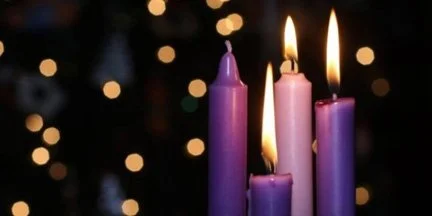
2nd Sunday in Advent
1 Peter 1:3-5; Romans 15:4-13
I’m using a resource this Advent, a book titled “Almost Christmas”…and the word “almost” suggests the special day is approaching soon and indeed, is very near. The writer of this week’s chapter, Ingrid, focuses on Hope. You see, she grew up in a family where her parent was a pastor, and they would have to move regularly. So, as a child, she hoped her family would not move, and she idealized those families that never seemed to move, who seemed to have a permanent location, like her grandparents’ farm, or her cousin’s home. She held out hope that she could one day have a home where she never had to move.
This was, of course, a young child’s perspective, and as we grow and become aware of the world, our understandings deepen, and we learn how to be not so self-focused, but rather, outward-focused, for we are created to connect with God and others, and to serve God and others. Ingrid came to understand that her “almost hope” was only focused on herself, and her needs. In order to embrace an “altogether hope” she would need to learn to lean on God when she might be moving to a new place or taking on a new job, and, she would need to open herself to be of service to others.
The difference between an Almost Hope and an Altogether Hope is the difference between going to our grandparent’s home, safe in the expectation that it will be a place where we are loved and cherished, and going to maybe an unfamiliar place, where people are so desperate to find food or shelter or warm clothing or medicine, that they have lost sight of hope entirely.
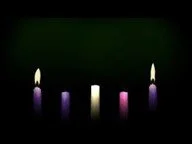
When we leave our comfort zone that is an “almost hope,” and venture into those unfamiliar places where God calls us to serve, we may not think we have much to offer. But what we carry with us, my brothers and sisters in Christ, is a light in the darkness, that shines in even the most hopeless of circumstances. For darkness cannot withstand the light, and the light will always overcome it. “Altogether hope” shines for all God’s children, through the birth of our Savior, Jesus Christ.
We hear that altogether hope in 1 Peter 1:3 “Praise be to the God and Father of our Lord Jesus Christ! In his great mercy he has given us new birth into a living hope through the resurrection of Jesus Christ from the dead,”
Imagine the hope that Mary, mother of Jesus, carried in her heart, as she and Joseph journeyed to Bethlehem. Realistically speaking, though, those of us who have been pregnant will understand that it cannot have been easy for Mary to even think about the hope of a coming Messiah, as she is jostled and bumped along the journey, riding on the back of a donkey for approximately 90 miles!
Through all the pain and suffering that we humans encounter, it is in the living hope that is Jesus Christ, who comes to us as a helpless infant, that enables us to find ease for our suffering, enables us to find comfort in spite of the pain we have encountered. The human condition is to be vulnerable, is it not? And how much more vulnerable can one be than as a newborn baby?
I’ve tried to imagine God choosing a different avenue than the Messiah, to help us to know the mercy and grace of God, and I’ve been unable to come up with any different story, than the one with Christ being born to human parents, and born poor and born at risk, and born in the midst of dirty, smelly, noisy animals! His journey is our journey, and our journey is a holy one, because he came here to journey with us, my friends, to lead us to God’s Kingdom.
Why can’t we imagine a better story? Because there is none better. Angels appearing to a variety of different people…Zechariah, whose wife will bear a child in their old age, and not just any child, but the child who will grow up to prepare the way for the Messiah! Joseph, who needed a little encouragement from an angel, to stay the course, to be there for Mary and this divine child. Mary, herself, learns from an angel that she is the chosen one to carry and birth this human and divine infant. And talk about seeking out those whom the world would pass by…the angels don’t choose to announce the holy birth to those in power in the community…the angels, an entire host of angels, appear to shepherds in a field, in order to make sure that people will be present at the holy birth who understand what Altogether Hope is. I mean, shepherds REALLY understand the import of the DIVINE arriving in BETHLEHEM in a lowly STABLE, and they not only witness the event, they go joyfully to spread the good news!
Angels, my friends. Well, I think you know how I feel about angels! They were there at the Divine Birth. And they are still showing up, still bringing Altogether Hope to all God’s children…not just a political few, but ALL God’s children. And we, as believers, have a responsibility to take up the Altogether Hope baton, and carry it, and it’s Divine Light, for all to see.
Just imagine if hopeful news came to us through the homeless?! Just imagine if hopeful news came to us through women, LGBTQ, people of color, people with disabilities?! We are too accustomed to believing that words of hope will come to us from the financial and political and societal power structures of our world. But God’s holiest work is being done now, and was being done 2,000 plus years ago, through people who live on the margins, who have been disregarded, disrespected, and dismissed by people in power for centuries.
Now, there are those who would disagree with this identification of those who bring words of hope. But I ask you what Ingrid asks, in her ponderings about hope: “when we’re comfortable, can we even hear the angels?” (p.48 Almost Christmas). Ingrid goes on to clarify why it is that those who are not in the power system are able to see and hear the angels and share the words of hope. “So often, people who are in some form of pain seem to hear and see much more easily. Pain often leads to hope because it requires hope – what else can sustain us when life is hard?” (p. 49 Almost Christmas)
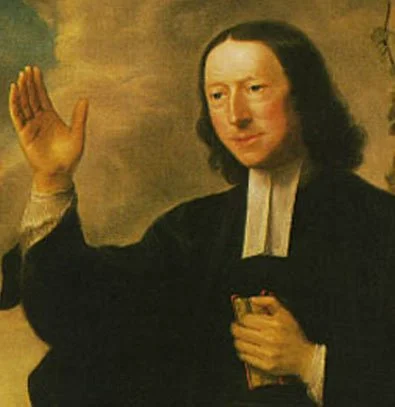
Ingrid, a “PK” (Preacher’s Kid) describes going on a family trip to the British Isles when she was a child. Her dad, she describes as a “John Wesley nerd.” So they had to go to all the places John Wesley had lived and or preached. There were places that John Wesley wasn’t welcome, but there were also places that John’s father wasn’t welcome. Hence, the famous story of John surviving the Epworth parsonage fire, at age five, in 1709, and his mother said he was “a brand plucked from the burning” (Zechariah 3:2)… she believed he was saved for a divine purpose.
Ingrid points out that she understood from a very young age that John Wesley was a fighter for those who were disadvantaged in life. And if he was not welcome in a particular place, to advocate for those who had no voice due to their lower status in society, he simply found another place to speak truth to power. Hence, the famous story of John preaching on his father’s grave because the church would not allow him in the pulpit.
Wesley’s persistence, advocating for those who had no voice, made a difference in the lives of many. How are we continuing Wesley’s example, to minister to and advocate for those who have no voice and live with no hope?
My friends in Christ, I ask you to consider three things, as we move through this season of Advent:
Think about a situation in your life that seemed hopeless. How did you make your way through?
What strange places (like a graveyard) are you willing to go for hope to be reborn?
In what ways can you be a presence of Christ’s light and hope, for those among your family and friends who may have lost hope? In what ways can you be a presence of Christ’s light and hope, for those in your church or social groups? In what ways can you be a presence of Christ’s light and hope, within the world?
Enough homework for today! Do I hear an Amen?
AMEN!
Pastor Elizabeth Bailey-Mitchell