4th Sunday in Lent
John 9:1-41
We began Lent with Jesus’s temptations in the wilderness. We experienced Jesus’s nighttime conversation with Nicodemus, and then we encountered the woman at Jacob’s Well in Sychar. You’ll notice that each week’s gospel passage thus far has highlighted Jesus’s lovingkindness. We also have been at a loss to understand the “how” of the Holy Spirit at work transforming lives.
This fourth Sunday in Lent, we are no closer to understanding the how of the Holy Spirit, in the story of the blind man who has his sight restored. We do understand that the story revolves around a key verb, “to know”, which in Greek is oida.
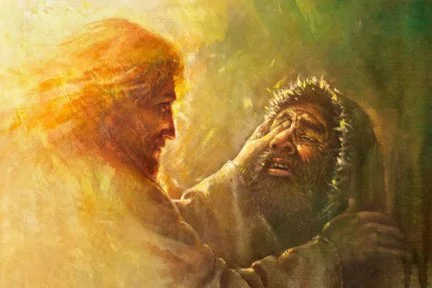
After Jesus makes mud with his saliva, and smears it on the man’s eyes, and sends him to wash, the man’s blindness is cured. He can see! The story then becomes what people know and don’t know. With a little tweaking of the words used, you almost could call it a comic wordplay, like Abbott and Costello’s Who’s on First. First, the neighbors either do recognize him as the local beggar, or they do not. All the time, the blind man, who now sees, is insisting, “it’s me! Kind of hilarious, because we all know that regardless of whether we have 20/20 vision or we are blind, our hair color, our height, our weight, the shape of our face, the clothes we wear, our skin color, all remain pretty much the same, from the years of blindness to the sudden healing and blessing of sight. So why would God’s miraculous healing of this man’s sight suddenly send his neighbor’s into a tit-for-tat argument about whether or not they recognize him? We might title this comedy “Believe It Or Not, This Dude Can See!”
The poor man just wants to give thanks and celebrate his newly found eyesight, but the Pharisees have other plans. They want to quiz him, to find out the “how” of this healing. And all the blind man, now sighted, will say, is that he just knows that Jesus put mud on his eyes, and he washed, and now he sees.
The Pharisees are focused on catching Jesus committing an offense on the Sabbath. Rather than celebrate that God has healed this blind man! And the Pharisees cannot comprehend how God would participate with this man named Jesus, in performing a miracle on the day of rest, the Sabbath. Why would God go against the rules? The Pharisees just couldn’t expand their understanding to include this possibility. The blind man, now sighted, is not in any way interested in getting Jesus in trouble for his healing, so what does he do? He simply tells what he experienced, what he knows, which is the truth. He tells the Pharisees exactly what happened, and that’s all he tells them. Again, the blind man’s parents have no interest in getting Jesus in trouble for their son’s healing, nor, possibly, themselves, so they simply tell what they know, and then refer the Pharisees back to the source of the experience of healing, their son.
But the Pharisees weren’t really interested in the truth as others knew it. They wanted their own truth verified and were not interested in trying to see the situation from any other perspective. They call upon the poor man again, not to celebrate with him regarding the miracle of sight, but to badger him some more. And why? Why could these learned, holy men not see the mighty work of God standing in front of them? Why could they not accept what this man knew, first-hand about this holy healing he experienced at the hands of Jesus?
Well, let’s think about this in our own experience of understanding something that is brand new to us. We live in a world that offers vast amounts of information at the touch of a digital device. We learn something that stays with us for a season, or a lifetime. Either way, it’s still hard to let go of one learning, when we find that new vision, new eyesight, new understanding, means we must let go of the former knowledge, which is in conflict with our new knowledge. It ain’t easy letting go, is it?! I’m sure we all can think of a situation in our lives where we stubbornly clung to a familiar, maybe a beloved idea that had become no longer relevant, when we are faced with the choice of making room for that new understanding, that new insight…but we just don’t want to make that leap, that change! To give one small example, I remember as a teenager, in Maine, there was a change in the blue laws, such that shopping malls were allowed to open on Sundays. Oh, my goodness, you should have heard the grumbling at church on Sunday, from those who liked having their “day of rest.” Me, being a typical teenager, I was thrilled to get to hang out with friends at the mall on a Sunday afternoon! The old blue laws were put in place to accommodate the religious understanding that Sundays were to be this “day of rest” and when that changed, some people really struggled, like the Pharisees, to adjust to something new.
The Pharisees were human, too, just like us. And they clung to what they had always known, because they didn’t wish to acknowledge the Son of God who had healed this blind man on the Sabbath. Acknowledging what God did through the Son of God would change everything. So, it’s far less scary for them to cling to what they have always known, rather than jump into the deep waters of what is completely new and yet to be experienced.
But the man who was healed? He knew in his heart, and in his eyes, in his newly found eyesight, that this Jesus was from God. And so, when Jesus asked, “Do you believe in the Son of Man?”, he said “who is he, sir. Tell me, so that I may believe in him.” And Jesus answered, “You have seen him, and the one speaking with you is he.” Now, you and I might have been so shocked, we could not speak. But the blind man, now blessed with miraculous sight, said, “Lord, I believe.”
So, we have a “knowing” that is comfortable, familiar ritual, that limits our lives and quite literally, our vision, and is not what God wants for God’s beloved children. And then, we have what the blind man experienced, which is a “knowing” that is faith, that is a belief in the loving, healing, transformative power of God acting for all God’s people, bringing us into the new life, the Kingdom life.
I mean, given a choice, it seems clear that when we trust God’s wisdom for our lives, and accept the new vision God gives us, well, then the sky’s the limit, right? God only wants to give us good things. So, we can maintain a grumpy attitude and hang out with Pharisees who protect the old blue laws of no work on the Sabbath, and watch all our friends doing the new and “forbidden” thing, going to hang out at the mall without us. Or, we can ask ourselves, with our new-found healed vision, “knowing that God is all-powerful, and God wants the best for God’s children, why can’t God make it so that we can worship God on a Sunday, AND hang out at the mall with our friends in the afternoon?!
During this Lenten season, as we encounter the wonder and mystery of the Holy Spirit’s how, let’s not get stuck there, because, my friends in Christ, we are human and therefore, it’s not for us to fathom that Holy how. Let’s just try to remember that when we see a reality that doesn’t fit with what we (currently) know, that might just be the holy moment when we find ourselves in the presence of God-at-work in our lives! And when we recognize that we are in the presence of God, what do we say? Something we say every time we find ourselves in the presence of God when we listen to or read holy scripture. Thanks be to God! Amen!