5th Sunday in Lent
John 11:1-45
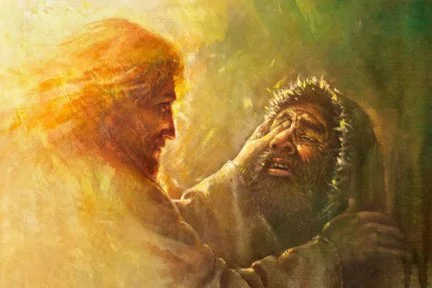
Last week, in our Gospel reading, Jesus told the disciples that a man born blind did not suffer that circumstance because he or his parents had sinned. The man born blind was to glorify God, through God’s powerful love and the miracle of healing of his sight. This was, no doubt, confusing to the disciples, who would have been steeped in their religious understanding of the time, which taught them that afflictions such as blindness were due to sin.
In this week’s Gospel reading, Jesus tells the disciples that upon hearing the news that his beloved friend, Lazarus, was so ill that he was about to die, Jesus knew that all would end in the glory of God. You and I, were we like the disciples, without benefit of being steeped in the miracle stories of the Gospels, would no doubt look at Jesus as if he had lost his mind. The disciples were probably thinking, how can Lazarus’s death glorify God? It’s hard to imagine how confused the disciples were, to see that Jesus did not immediately drop everything, to go to his beloved friend, Lazarus.
But love, here, takes a different form than we normally experience. Love, in the story of the resurrection of Lazarus, is something like those kaleidoscopes you used to look through, as a kid, and see an awe-inspiring multitude of colors and shapes. A kaleidoscope transforms ordinary objects and light into beautiful symmetrical art. Picture the kaleidoscope of transformed mourning, as Martha grieves her brother’s death, and point-blank tells Jesus, “had you been here, you could have healed him.” Yet, even in her “ordinary grief,” Martha’s faith sparkles, like the tiny bits of glitter in a kaleidoscope, tumbling and turning. The kaleidoscope mirror magnifies that sparkle, transforming her mourning into an opportunity to glorify God for the resurrection of her brother.
My friends in Christ, Martha has walked through the valley of the shadow of death, yet even in that dark place, Martha does not doubt the love of Jesus, for her, for her sister, and yes, for her beloved brother, Lazarus. Her faith sparkles, and God’s love shines, and she knows by faith that Jesus is indeed, the Messiah, the Son of God.
Mary comes to Jesus in the same way as Martha, telling Jesus she knows his presence at her brother’s sickbed could have turned things around. But her posture is such that we know she is not angry with Jesus, since she kneels at his feet, a way of honoring his presence and his love for her, for Martha, and for her dead brother, Lazarus.
And here it is that we witness the intimacy of mourning. Jesus weeps. He witnesses all who loved Lazarus and deeply mourn his death, and he weeps. His love for Lazarus is an integral part of his love for each and every child of God, for whom Jesus knows he will give up his life, so that we all may know freedom from sin, and life eternal.
My friends in Christ, what do we do, today, to show our love for God, for one another, and for ourselves? If death is inevitable, as it was with Lazarus, and as it was with Jesus, are we living our lives to honor this gift that is life? And, more than that, how are we living, having heard today’s Gospel, and understanding how Christ glorified God through the resurrection of Lazarus. How are we glorifying God, knowing that our beloved Savior died, and rose again, so that he could prepare a place for us, in the peace that is the Kingdom? Do we live our lives as active witnesses, living in peace and joy, as we anticipate the eternal joy of the Kingdom?
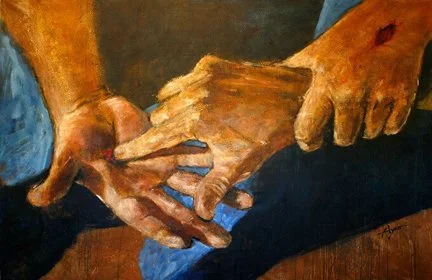
We see God’s hand at work in the Gospel stories. A blind man healed. Lazarus resurrected. Lives transformed. All because of what? All because of God’s deep and abiding love for us. As a consequence, are we living our lives transformed? Are we living in awe of the kaleidoscope sparkles that God has gifted us through the love of Jesus, the One who suffered our human death, and rose again, to bring us that new life…those sparkles of new perspective in a weary world of sin and pain and death?
Last week, we talked about the Greek verb, oida (to know), as we explored how the healing of the blind man glorified God. This week, the verb appears again, in verses 22 and 23, when Martha speaks of what she knows. Martha says to Jesus, “But even now, I know that God will give you whatever you ask of him.” And Jesus says to Martha, “Your brother will rise again.” Martha is mourning deeply, and in her grief, calls out her pain, by pointing out that if Jesus had only come sooner, her brother would have lived. And yet, even in her grief, her faith guides her to say to Jesus, in verse 27, “Yes, Lord, I believe that you are the Messiah, the Son of God, the one coming into the world.”
Wow! Now, that’s some powerful oida! That’s a deep, deep knowing! That’s a faith that shines even when, and perhaps, especially when, one’s heart is deep in mourning. Martha, in spite of her sorrow, by faith, trusts that the Messiah is with her, not just in this time of wrenching sorrow, and not just for her, but for all of us, at all times, and for all peoples! Can’t you just see those kaleidoscope salvation sparkles, through the tears of our earthly sorrows?!
God knows this earthly life we live can be bone-wearying. And so, God sends not just his love in a letter to us, but the real deal, his only Son. A special kind of courier that brings a message of love that melts to our sinful core, grants us forgiveness, relieves us of the burden of sin that wears us out, and hands out kaleidoscopes for everyone, saying, “look, the Kingdom is near! Repent and turn to God! Know that God delights in all of God’s children, each one of you! Celebrate the sparkle that is salvation!”
Mind you, I’ve paraphrased a wee bit. We do find the phrases, “Look, the Kingdom is near. Repent and turn to God” in scripture. But I might have taken some liberties with the salvation sparkle kaleidoscopes!
My friends in Christ, I feel that Jesus is blessing that kaleidoscope image. And why? Well, let’s look at verses 25 and 26. Jesus’s conversation with Martha. He says, “I am the resurrection and the life. Those who believe in me, even though they die, will live, and everyone who lives and believes in me will never die.”
If you’ve ever been to a funeral, you have likely heard John 11:25-26 quoted. Because those words are words not of death, but of death conquered through our risen Lord. Those are words of life, and life eternal. You see, when we call a funeral a celebration of life, while it is certainly a time of remembering the earthly life of the beloved person, we are, indeed, gathered to remember that Christ came and lived our life, died and was resurrected, so that we could truly celebrate the eternal life to come, for all who believe.
Yes, Jesus wept, as he stood with Mary and the others gathered. But his tears were a mix of mourning the earthly joy of knowing Lazarus, and a mix of celebrating the opportunity to glorify God and show those gathered that the Messiah had come, to bring new life.
Let us pray: O Creator, God, we give thanks that you were glorified through the resurrection of Lazarus. We give thanks that through the resurrection of your one and only son, Jesus Christ, you hand out kaleidoscopes to all, so that we may rejoice in the transformed sparkle and joy that is our new life in the Kingdom. In Jesus’s name we pray, Amen.
Pastor Elizabeth Bailey-Mitchell