5th Sunday after Pentecost
Matthew 10:40-42
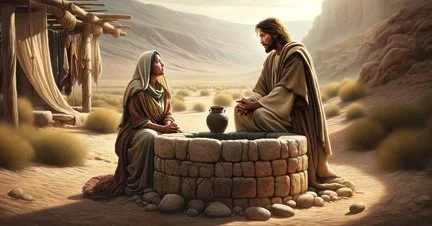
As we move into the summer season, we know how refreshing a cup of cold water can be on a hot day, especially if we’ve been working outside under a hot sun. In today’s Gospel passage, Jesus speaks to a universal physical need – to quench one’s thirst – and he points out one of the simplest ways to meet that need…a cup of cold water.
Jesus encourages us to be open to those who can help us to deepen our spiritual journeys: welcoming those who preach about Christ into our lives; welcoming Christ into our lives; welcoming God into our lives; being open to listening to the wisdom that a prophet brings into our lives; and welcoming a righteous person into our lives. Being open to welcoming those who can share with us the meaning of having the Messiah present in our lives is vital to our journey on the Way of Salvation. And today’s scripture assures us that if we open ourselves to embracing all who point the way to God, and welcome them with even something so simple as a cold cup of water…we will be rewarded, “…the reward of the righteous…” (Matthew 10:41)
Now, the curious thing is, Jesus is talking about all of this welcoming of prophets and righteous people and all, without actually telling us how to know who to look for. I mean, how does one tell a prophet from someone trying to fool us? What if we welcome a person into our home whom we thought was righteous, but then we find out they are not at all to be trusted? Not all people helping to point the way to God wear the robes of a priest, but how do we know who is genuinely God’s messenger? And about this reward…is it really so simple to receive… just by engaging in the compassionate offering of a cup of cold water to someone who is thirsty?
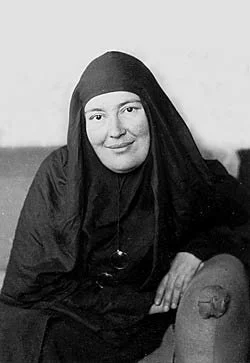
I’m going to tell you now about a woman whose life has touched my heart, and she is just the kind of unusual saint that Jesus would have had in mind, when he talks here about giving a cup of cold water.
Her given name was Elizaveta Pilenko, a woman born in Russia in 1891, in what is now Latvia. She took a very circuitous journey towards her eventual life’s work, which was as an Orthodox Nun, taking the name of Mother Maria Skobtsova. Perhaps I should begin by sharing a poem about her, whose author I do not know. This is the poem:
“She smokes and drinks. She doesn’t collaborate well. The church doesn’t know what to do with an Orthodox Nun in the world. She is twice divorced and doesn’t seem to be able to live by anyone’s rules, except God’s. She often leaves church before it ends or sometimes doesn’t go at all. A Christian who wore a Star of David and stood up to Nazis. Her door is always open. Her table is always spread wide ready for the next one. She was warm and funny. The best people love her, and the worst people killed her.”
That poem really gives a very clear snapshot of her life. A few other snapshots will give us insight into how we might learn from her life’s work, which she devoted to God, serving those most in need. As a youth, losing her father at a young age, she at first became an atheist, but clearly, God had a mission for her, and that mission wouldn’t be accomplished by opposing God’s purpose for her life. She married, she divorced, the White Army put her on trial as a Bolshevik and the judge who held her life in his hands acquitted her and then fell in love with her and married her. With her second husband and her mother and the child from the first marriage, and she herself being pregnant with her second child, they fled Russia for Georgia, then Yugoslavia, and finally, ending up in Paris. They had several children together, one of whom died young of influenza. And their son, Yuri, would end up being put to death at the Dora-Mittel Bau concentration camp.
What words might have caused her second husband to fall in love with her? She said this, in court, defending herself against the White Army: “My loyalty was not to any imagined government, but to those whose need of justice was greatest, the people. Red or White, my position is the same – I will act for justice and for the relief of suffering. I will try to love my neighbor.”
After her daughter’s death, Elizaveta understood that God was calling her to share the love she had for her daughter with all people, especially “for all who need maternal care, assistance, or protection.” She wrote that she was led to a “new road before me and a new meaning in life.”
As she developed a practice of serving the poorest of the poor in Paris, she was invited by the church to become a nun, and agreed to do so, if she did not have to go live in a convent, as she felt her call was to be among the people and serve the poor. So, her marriage was annulled and she became Mother Maria Skobtsova, and became part of the resistance movement in France during World War II. When some Christians of that era tried to look the other way, as if the tragedy of the Jews was not their problem, Mother Maria said this: “There is no such thing as a Christian problem. If they’re coming for the Jews, they’re coming for the Christians. Our destiny ought not be separable from that of the Jews, because we are in the same story as they are. So, yes, we ought to wear the yellow star.”
Mother Maria could have left Paris for safety, but she remained, feeding and housing the refugees, and working with a priest to provide false baptism records for Jews, to protect them from being collected and sent to the concentration camps. Until, of course, they themselves were caught.
A woman who was at Ravensbrück concentration camp and survived, remembered Mother Maria. Solange Perichon said, “Mother Maria had used the ever-smoking chimneys of the camp’s crematoria as a metaphor of hope rather than being seen as the only exit point from the camp.” Regarding the smoke of those chimneys, Mother Maria said, “When they rise higher, they turn into light clouds before being dispersed in limitless space. In the same way, our souls, once they have torn themselves away from this sinful earth, move by means of an effortless unearthly flight into eternity, where there is life full of joy.”
Another survivor of the Ravensbrück camp, Rosanne Lascroux, recalled, “She exercised an enormous influence on us all. No matter what our nationality, age, political convictions – this had no significance whatever. Mother Maria was adored by all. The younger prisoners gained particularly from her concern. She took us under her wing. We were cut off from our families, and somehow, she provided us with a family.”
Mother Maria was chosen on March 30th, Good Friday, to be sent to the gas chambers at Ravensbrück concentration camp. She entered eternal life on Holy Saturday. Mother Maria Skobtsova was canonized as a saint on January 18, 2024, by the Eastern Orthodox Christian Church, along with her son Yuri, and priest, Dimitri Klepinin, and Mother Maria’s close friend, Ilya Fondaminster.
Mother Maria lived the liturgy. She believed that when you’ve shared in the worship of the Eucharist – holy communion – then you’ve got to go out and live eucharistically. Living in the world as if the world is a sacrament itself. Living in the world as a sacramental person, making yourself available to be eaten and drunk by those around you. She called this the “liturgy after the liturgy.” “It leaks out of the doors at the back of the church. The power of Divine presence and Divine invitation in the Holy Eucharist is something that cannot be contained behind locked doors. And therefore, the liturgy is vital and central because it generates changed lives and changed relationships. It’s a very intense, uncompromising account of Christian love. Love is not a feeling, not even a set of actions. Love is the state in which we live. Love is the nature of the connection that God has made between us and others in and through the Holy Spirit, in the likeness of Christ.”
Mother Maria is the shining example of what it means to give a cup of cold water to God’s children. She did so with compassion and sacrificial love, just as Jesus teaches us to do. I’ll close my tribute to her work for the Lord with one more quote, “I am your message, Lord. Throw me like a blazing torch into the night, so that all may see and understand what it means to be a disciple.”
May we learn from her example, as we go into the world today, carrying the light and love of Christ for all, and offering a cup of cold water. Amen.
Sources: Rowan Williams’ 2025 seminar on Mother Maria; Center for Excellence in Preaching, Commentary on Matthew 10:40-42 by Chelsey Harmon
Pastor Elizabeth Bailey-Mitchell