4th Sunday after Pentecost
There’s a movie titled “Life as a House” produced in 2001. If you haven’t seen it, and you’re looking for a good movie, you might want to check it out. It’s got some really good actors, but even better, it has a moving storyline about grace. The main character, George, is a divorced architect living in a shack on the California coast. He doesn’t want to adopt new architectural technology into his work, and this eventually gets him fired. He is diagnosed with terminal cancer. He decides that in the few months he has to live, he is going to tear down the shack and build a home. He asks his estranged son, Sam, to help him. Sam resists by getting in trouble with the law for stealing Vicodin. To complicate things even more, the married ex-wife shows up. In addition, a classmate of Sam’s volunteers to help with the build, as do two of Sam’s half-brothers. Throughout the film, the architect and his son work on reconciling their relationship, and the building of the house becomes a metaphor for rebuilding his life, even as he is dying. It’s not a movie designed to promote Christianity – dying to one’s old life and living, by God’s grace, a new and transformed life. And yet, George and his son, Sam, find a way to do this, together, while literally tearing down the old shack (the old way of living), and building a new home (the new way of living), effectively leaving “the old country of sin behind…(and entering) into the new country of grace.” (Romans 6:3)
I wasn’t sure if I should use the film to illustrate today’s scripture, because it’s almost too literal. George is physically dying. And Christ is not requiring that of us, in order to enter into the new life by God’s grace. We can know that grace here and now, and know that transformed life, that radically changed life, here and now, because Christ took on our sin, and died our death, to free us all from sin and death.
The apostle Paul explains this life and death and new life not in terms of a biological life and death, but rather, a spiritual one. The apostle Paul impresses upon us the fact that we humans are so beloved by God that God does not want us to live as if we are dead, as if we are walking zombies. God does not want us to be stuck in sin. In Romans 5:20-21, The Message paraphrases Paul’s words to explain it this way: “When it’s sin versus grace, grace wins hands down. All sin can do is threaten us with death, and that’s the end of it. Grace, because God is putting everything together again through the Messiah, invites us into…a life that goes on and on.”
When people ask why we come together once a week in church, we might speak to any number of reasons: we love the music; the sermon is food for thought for the week; the sanctuary is peaceful; we like coffee fellowship after church (and miss it during summer break!); we enjoy seeing friends we might not see during the week.
But deep down…deep down, why do we show up on Sunday? Isn’t it because you have experienced a love that the world can never give you? Isn’t it because you feel that love, that love for you, as everlasting, nurturing, uplifting…the kind of love that is not going to desert you if you mess up in this ever-challenging life we live? The kind of love that will take your hand and walk with you through whatever mess you got into, and help you get out the other side of it? God is the ultimate architect, and God has created a glorious new home of grace for us, and every Sunday, we get together and marvel at God’s grace in our lives. Granted, the wreck of the old home of sin may be right next door, and maybe it feels like we only just left the old place yesterday…but the joy is that we can appreciate and give thanks to God for this new state of grace we have moved into. (Do I hear an AMEN?! AMEN!)
And, because grace can’t be grace if it’s being hoarded, we have the great privilege and joy of inviting others to come to know God’s incredible love, and experience God’s amazing grace! God’s grace in our lives is not ours to command nor ours to dish out to a select few, nor something we can bury as our own little secret treasure.
Sharing God’s love and talking about God’s grace is what we, as Christians, do. And, sometimes, that love and grace sharing may not even be with words, but in our actions. And why would we want to do all this sharing, and grace-filled action? Because somebody did it for us, to help us to know God’s grace and love. That somebody gave you a gift you can never repay. Except, perhaps, by passing on the gift.
John Wesley, the founder of Methodism, writes about different kinds of grace in our lives. Prevenient grace is something so beautiful it’s difficult to put into words. It’s a grace that makes you just stand in awe of its power and beauty. Prevenient grace is God’s grace at work in our lives before we are even aware of it. No church building necessary for prevenient grace to be at work. No Sunday School or Bible study class attendance check, to make sure you’re prepared for the prevenient level of grace. God’s prevenient grace just shows up, steady and warm and enveloping and, well, just with you. You don’t even know God is there, until, well, you take a look-back, one day, standing in the doorway. You see, Wesley describes prevenient grace as the porch on a house. And justifying grace is the doorway from the porch into God’s house of salvation. “Justification,” writes Wesley, “is another word for pardon. It is the forgiveness of all our sins, and ... our acceptance with God.” (A Wesleyan Understanding of Grace, www.resourceumc.org/en/content/a-wesleyan-understanding-of-grace)
John Wesley’s experience at a Bible study on Aldersgate Street, May 27, 1738, gives us an idea about what justifying grace is all about. He writes “About a quarter before nine, while he [the leader] was describing the change which God works in the heart through faith in Christ. I felt my heart strangely warmed. I felt I did trust in Christ, Christ alone for salvation and an assurance was given me that he had taken away my sins, even mine and saved me from the law of sin and death.” (ibid)
So, justifying grace, in today’s language, might be when we have that “aha” moment, when we “get it.” When we understand, in a heartfelt way, a Holy Spirit-led way, what Christ has done for us.
We’ve made it from the porch to the doorway. Where do we go from here? “If prevenient grace is the porch of the house of grace and justifying grace is the doorway, sanctifying grace represents the rooms in the expansive dwelling of God’s presence with and purposes for humanity.” (ibid)
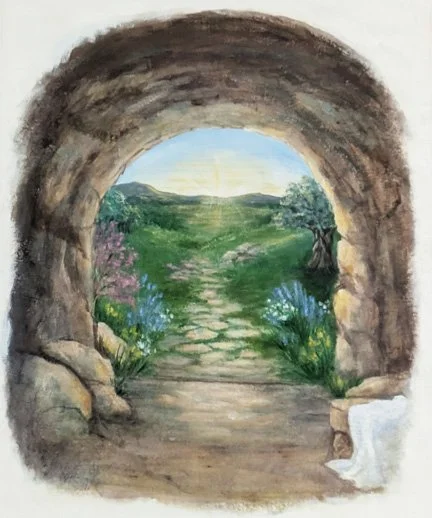
Purposes for humanity? What could God’s purpose be? Well, for starters, if we are made in the image of God…(and we know from scripture that we are!) then God has no intention of just leaving us hanging out on the porch, as enjoyable as prevenient grace may be. And God would not invite us to the doorway, to experience the life and sacrificial love of Jesus Christ, and the forgiveness of God, and then just shut the door. If we’ve made it to the doorway, and if we see that the doorway is wide open, and if we see that God is smiling and beckoning us in, well, then, my friends in Christ, that’s all the invitation we need to experience the fullness and richness that is sanctifying grace! That’s all the invitation that we need to move right in and bring our family and friends with us! In God’s sanctifying grace, we experience the Divine within us, healing us and restoring us to the fullness of God’s image in us. Sanctification is a process, as we are being made perfect in love, and as we leave the desire to sin behind us, in the old house, where we no longer desire to live. Wesley writes about sanctification in his sermon “Christian Perfection.” And when he writes about perfection, he is not saying that we will not make mistakes, but rather, we will move towards a “holiness of heart and life.” (ibid)
So, coming together in God’s house, once a week, helps us in this journey towards a holiness of heart and life. And exploring the gift that is God’s grace, is a joyous moving day party, packing up and waving goodbye to the old home of sin, and joyfully unpacking and moving into the new home of grace! May God’s grace be with us, always! Amen!
Pastor Elizabeth Bailey-Mitchell